Com&Com

News

Youtube Wikipedia Twitter Facebook Instagram
16.1.2026

Bloch is back, but..

So far, no agreement has been reached on cost sharing with the logistics company that shipped the art tree Bloch from Chile to India in 2024 and caused the situation there, resulting in a re-export at the end of 2025 without achieving an import. As a result, Bloch is blocked once again, now almost at the doorstep, in the container port of Basel. Today, Tagblatt, Appenzeller Zeitung, and TVO reported on it.
Tagblatt: Link
Appenzeller Zeitung: Link
TVO (Eastern Switzerland):  Link 1 /  Link 2

25.11.2025

Bloch on the way home

After Bloch had been blocked for over a year, things suddenly moved fast.
If everything goes smoothly, Bloch should arrive back in Switzerland by the end of the year.

1.7.2025

India Update

After Bloch was blocked in the port of Mumbai for almost a year due to incorrect declaration and was not allowed to be imported into India, the entire India tour was lost. At one point, the auction of the container and its contents was even threatened (see Photo), which would have resulted in a total loss. This was prevented only through lawyers and the intervention of the Swiss embassy and the consul. Thanks to everyone who helped save Bloch. 🙏

25.7.2024

Bloch on its way to India

After years of standstill due to the pandemic and political unrest, and after several failed export attempts, Bloch finally left Antofagasta, Chile, on 18 July. After a short stop in San Vicente and a stopover in Hong Kong, the journey continues to India, where it is expected to arrive in Nhava Sheva at the end of September.

In India, a tour of almost two years is planned. It will begin with an exhibition and residency at the Sunaparanta Goa Centre for the Arts, followed by appearances at the Serendipity Festival Goa. After that, a tour to Kochi, Bihar, and Delhi is planned, with collaborations involving numerous Indian artists. To prepare this programme, a preparatory trip already took place in 2023, including visits to Mumbai, Goa, Kochi, and Delhi, and meetings with many institutions, curators, and artists.

5.6.2024

Born digital (video art)

If you happen to be in Zurich this Thursday June 6, please join us for the opening at Kunsthaus Zürich.
BORN DIGITAL – Video art in the new millennium
June 7 – Sep 29, 2024; Opening June 6 (5-9pm)
Introduction 7pm by Ann Demeester (Director) and Éléonore Bernard & Luca Rey (Curators)

With works by: Christoph Büchel / Com&Com (Hedinger/Gossolt) / Cao Fei / Gabriela Gerber/Lukas Bardill / Zilla Leutenegger / Tatjana Marušić / Rita McBride / Yves Netzhammer / Pipilotti Rist / Diana Thater / Susann Walder

They show the early videowork by Com&Com: „I love Switzerland“ (2002), the second part of our Swiss Trilogy (2000-2002). It was first shown at the EXPO.02 in Harald Szeemann’s exhibition „Geld und Wert – das letzte Tabu“. The Video was co-produced with Theater Luzern and Twin Productions and it is in the Kunsthaus Zürich’s a media art collection since 2002.
More about the exhibition  / More about Com&Com’s early videos

20.2.2023

Invitation to India

Over the past two weeks Johannes spent time in India on a research trip supported by the Swiss Arts Council to prepare the next Bloch tour. He researched in Mumbai, Goa, Hampi, Kochi, and Delhi. also he gave three public talks in Mumbai at G5A, in Goa at Sunaparanta, and at the Kochi Biennale. Bloch is planned to tour India for over a year, starting in Goa in autumn 2023.

5.1.2023

Artivation #2 : Happy New/Old Year

While in Tenna, Grisons, in the Swiss Alps, shortly before midnight of the year 2022, Com&Com made a video call via WhatsApp. The artists spoke with the artist Dharmendra Prasad and the curator Shazeb Sheikh, with whom they had just opened a joint exhibition.* Because at the time of their conversation, both Shazeb and Dharmendra were in India, they were already several hours into the year 2023. India was in the future. This inconspicuous event (of a WhatsApp conversation) lent itself to another iteration, and they thus decided to reenact it exactly the same way shortly after midnight—having arrived in the meantime in the year 2023—by sending a text message in the other direction to the curator Nora Hauswirth in Manaus, Brazil. The message was sent to the past.

What Com&Com engaged with was a Fluxus event score In One Year and Out the Other written by Ken Friedman in 1975. The score reads “On New Year’s Eve, make a telephone call from one time zone to another to conduct a conversation between people located in different years.”

Today known as an artist, author, educator and design researcher, Ken Friedman  (*1949) was the youngest member of Fluxus, when he joined the group on Maciunas’ invitation in 1966. During the heyday of Fluxus, Friedman worked closely with other Fluxus artists and composers such as George Maciunas, Dick Higgins, and Nam June Paik, as well as collaborated with John Cage and Joseph Beuys. He was also the general manager of Dick Higgins’s Something Else Press in the early 1970s.

Friedman’s In One Year and Out the Other was first performed on New Year’s Eve in 1975, when Friedmann—based at that time in Springfield, Ohio—first phoned ahead to Dick Higgins, Nam June Paik, Peter Frank, Christo and Jeanne-Claude in New York, who were already in the year 1976. Then, after midnight, he called back from 1976 to Tom Garver, Natasha Nicholson, and Abraham Friedman in California.

The spirit of Ken Friedman’s score is alive and well today, although it has mutated since to take alternative forms. Television broadcasts, social media posts, texting and email are just some of the adaptations that fit within the most straight forward parameters of Friedman’s idea: to connect individuals and communicate between times and temporal zones.

The work, like many Fluxus works, at the first glimpse straight forward and easy-to-enage-with, asks significant questions about how we understand time and space, and what it means to measure time with mechanical means. Dennis Oppenheim pointed to the absurdity of marking time as territory and political boundaries in his Time Line (1968). What do such artificial, political and temporal zones and distances mean in a world connected via digital media, where everything seems to be just a mouse click away? How does the “new year” feel like as an anticipation or as an accomplished fact? Can we manipulate, rewind, and recover time?


*«Gras Geschichten / Stories of Grass» by Dharmendra Prasad. An exhibition curated by Shazeb Sheikh und Johannes M. Hedinger at the Institute for Land and Environment Art ILEA in Tenna, Safiental (December 31, 2022–October 29, 2023).

29.12.2022

Artivation #1: Zen for Internet

Over the next four years, within the framework of the research project SNSF Activating Fluxus, you may expect to encounter “Artivations,” that is, artistic activations – adaptations, (re)enactments, (re)interpretations, and new productions. They will be done in the spirit of Fluxus, the avant-garde movement that changed, in the 1960s and 70s, how art is done and what it means to create an artwork. They will be initiated, curated, and, at times, created and executed by the Swiss art collective Com&Com, founded in 1997 by Marcus Gossolt and Johannes M. Hedinger.

In 2014, invited to contribute to an exhibition Revision: Zen for Film at Bard Graduate Center Gallery New York (September 18, 2015 – February 21, 2016), they created a work titled Zen for Internet.

Using the iconography of the internet and computer, the work features an endlessly rotating “loading wheel” on a white background. Typically, the “loading wheel” would be a temporary, in-between state before seeing the fully loaded image. Zen for Internet, however, indefinitely freezes the in-between-ness; the viewers never see the desired image.

The work refers directly to Nam June Paik’s iconic work Zen for Film (1962-64). Fifty years after Paik’s intervention, the Swiss artists decided to continue, in the digital world, the themes inherent to Paik’s work such as Zen, silence, nothingness, boredom, trace, chance and materiality.

The artists conceived of  Zen for Internet existing in multiple iterations in a variety of media: as a website (www.zen-net.org), a thirty-minute video (accessible on YouTube and below), a painting, and as various types of merchandise including t-shirts, pillows and tote bags, as seen on the image down below. In addition to appropriating the themes of duration and nothingness from Paik’s Zen for FilmZen for Internet speaks to the inherent mutability of a Fluxus work and to the changeability of its concept. Rather than existing in a single instantiation, Zen for Internet work can exist in a variety of formats, just as Zen for Film existed in an assortment of contexts, all of which were still “authentically” the work.

But in the context of the project, the relevant questions raised by this work are: What does it mean to activate a historical, canonical, and seemingly well-known work (on this topic, see Hölling, Revisions: Zen for Film, 2015) in the digital age and for the post-digital audience? How can a work be revived, or revitalized, in a world which is different from how it was back in the 1960s? Can intermediality be thought of on a larger timescale to involve intergenerational shifts, adaptations and borrowings? What can creativity, artistic interpretation, and appropriation bring into the picture of conservation? And, last but not least, how to preserve boredom without being bored, and boring?

15.3.2022

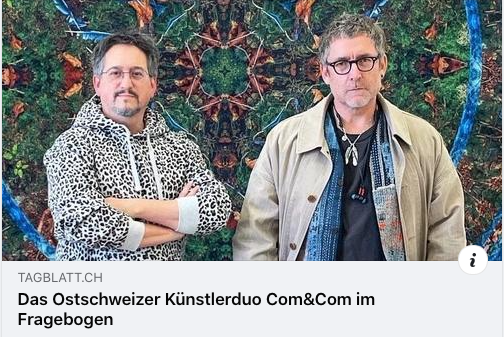
Questionnaire Tagblatt

What Com&Com is currently learning and for what they are looking looking forward – questionnaire at Tagblatt
14.1.2022

EST. 1997

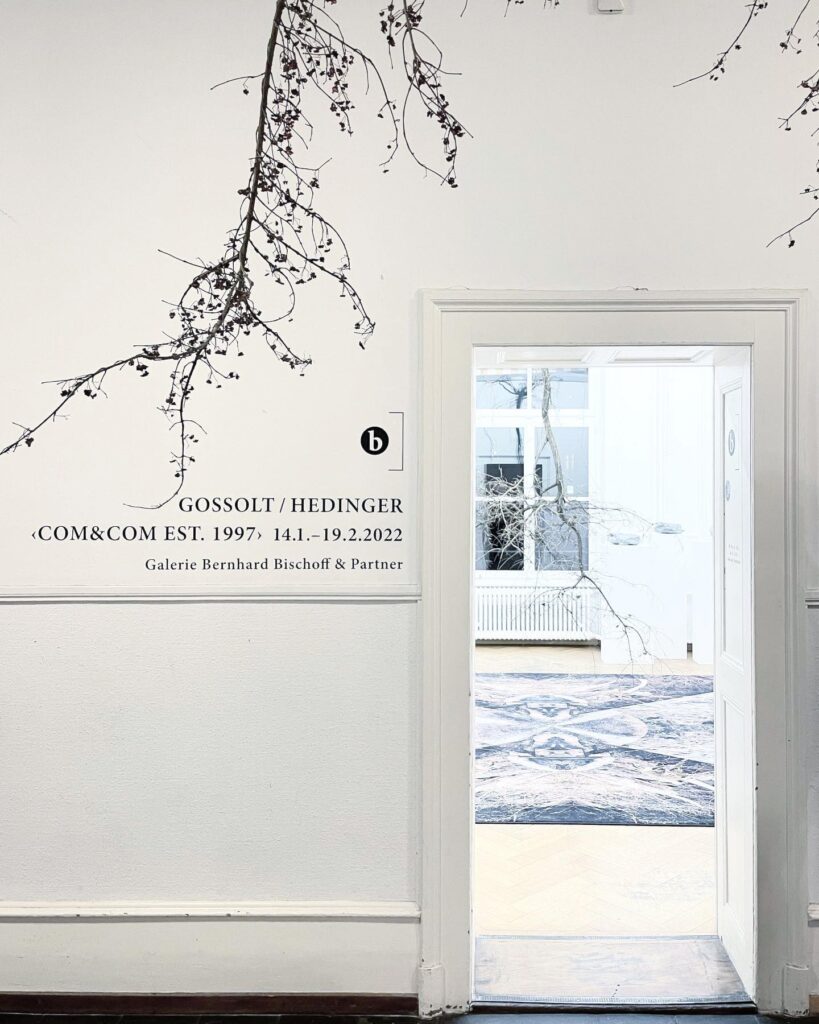
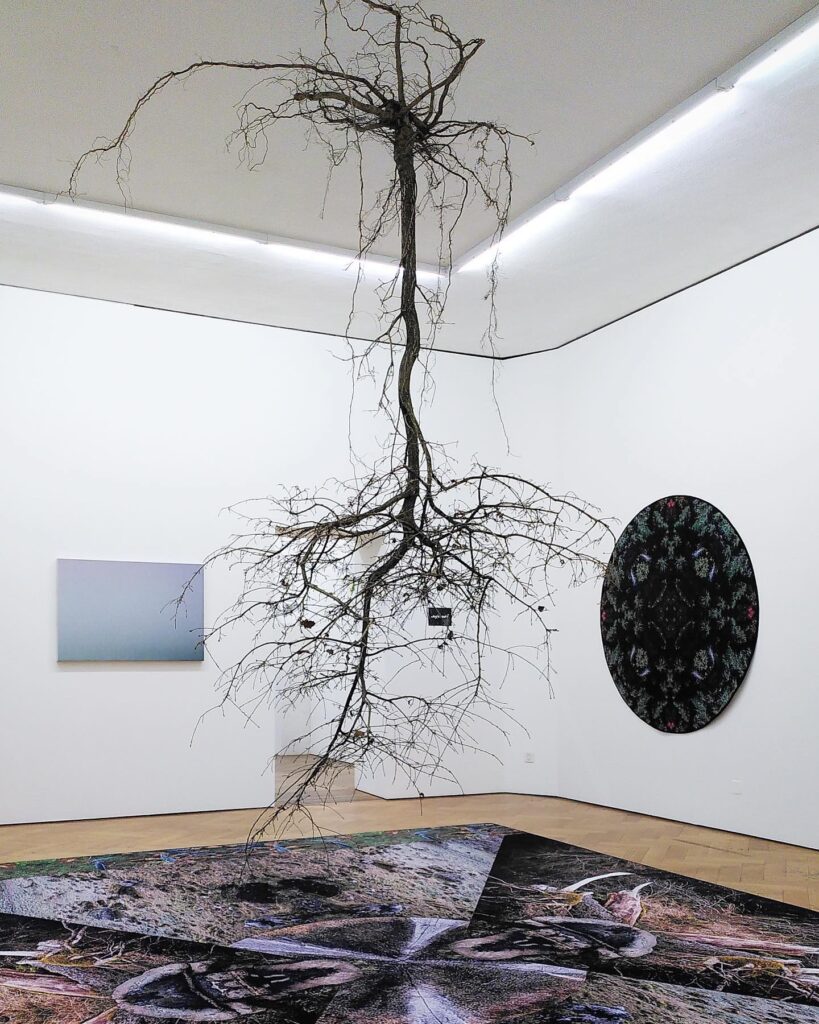
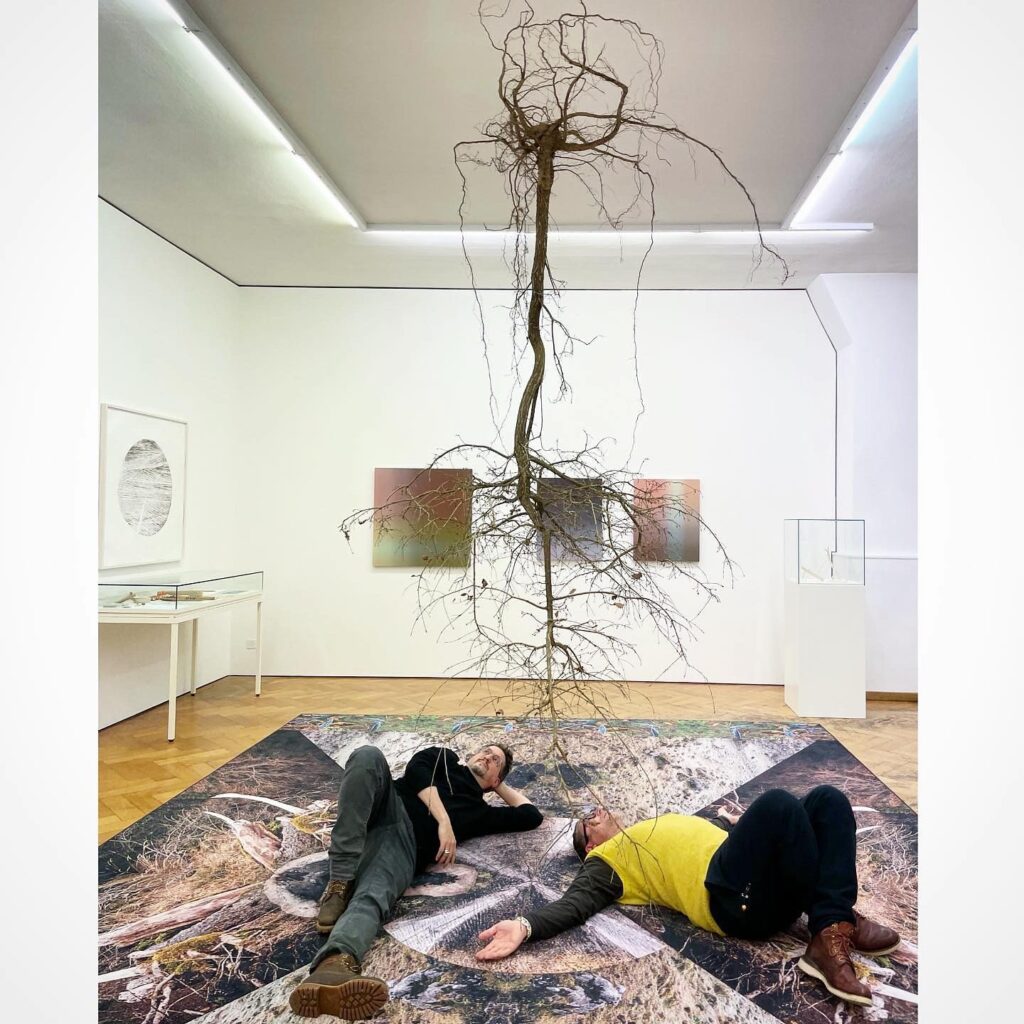
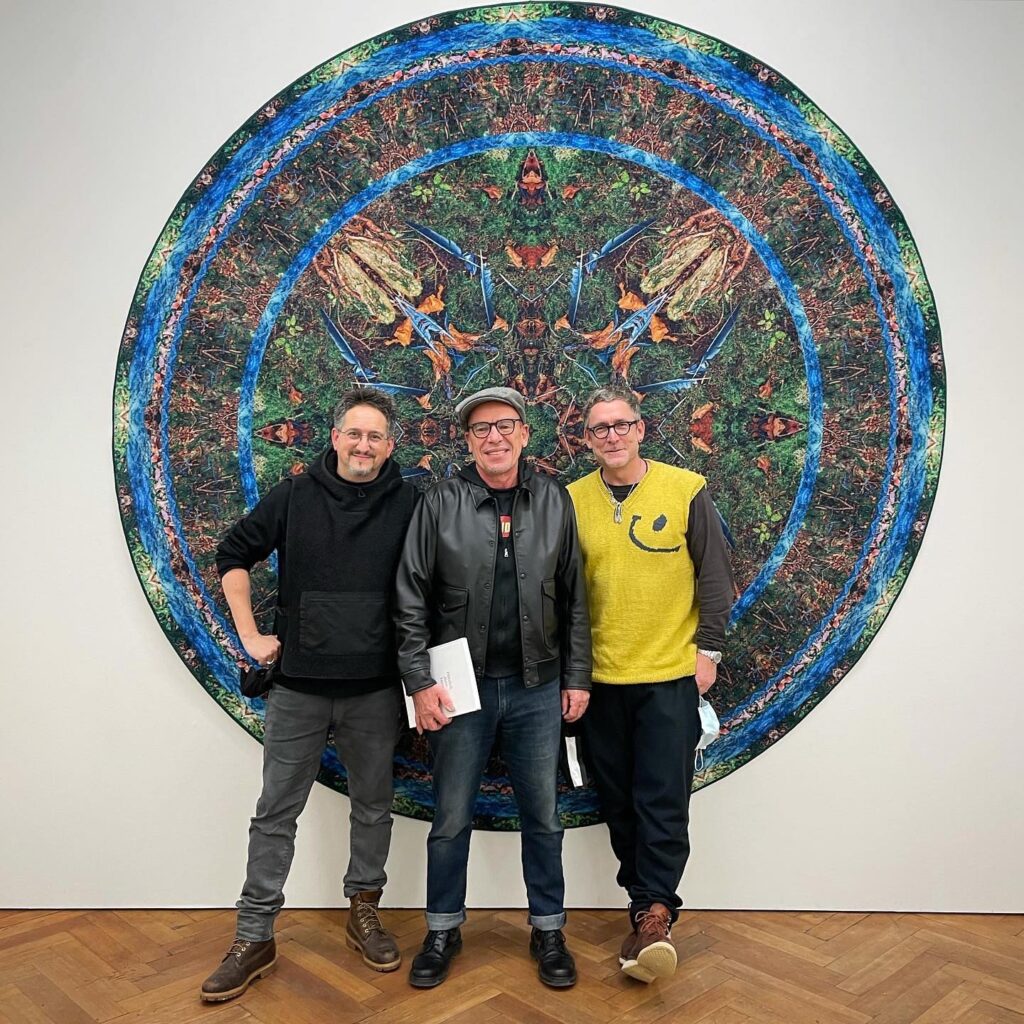
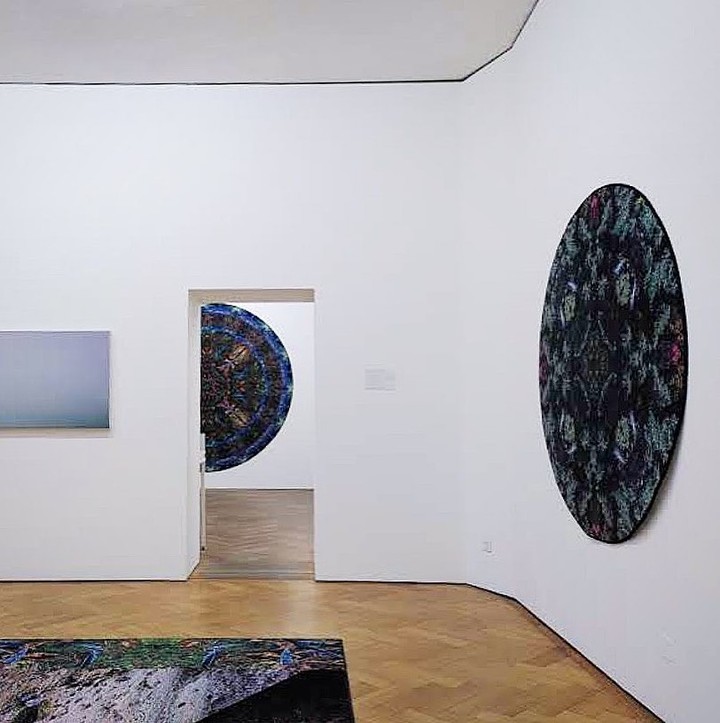
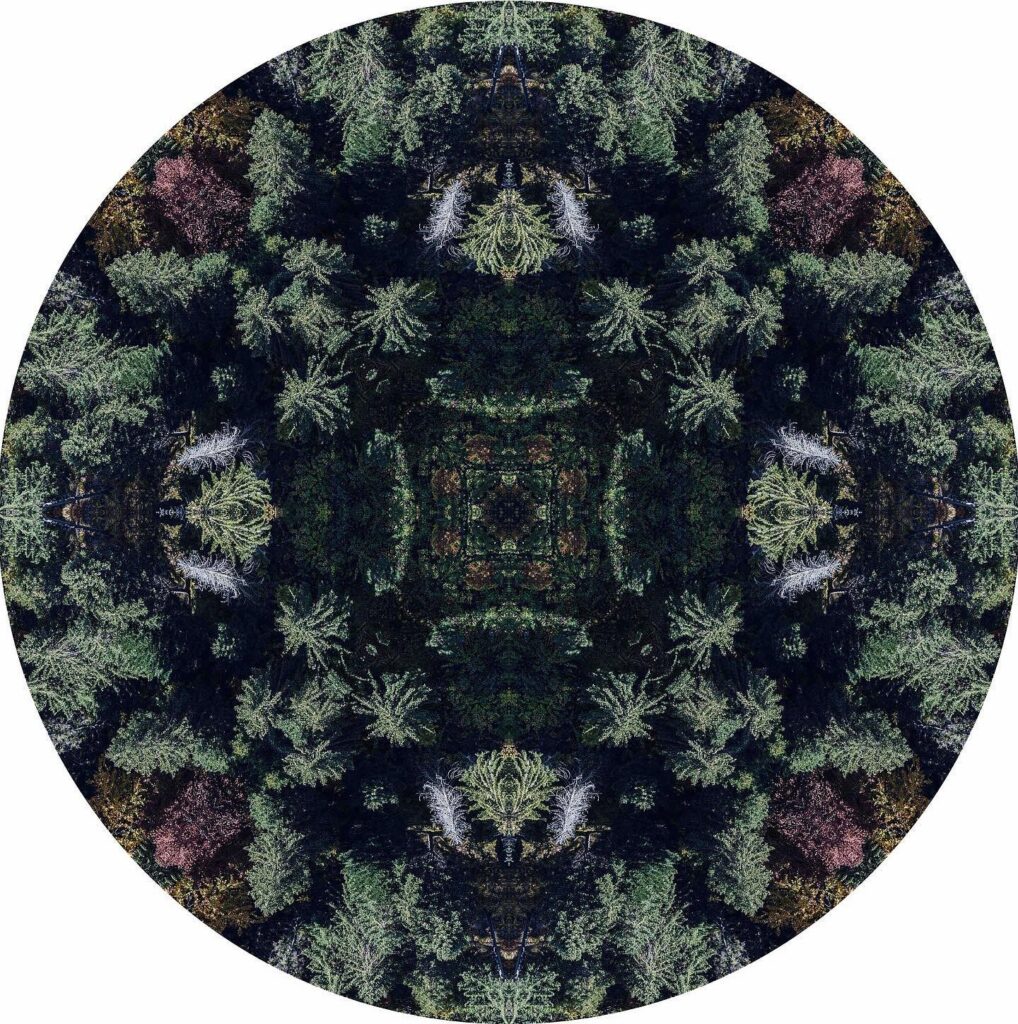
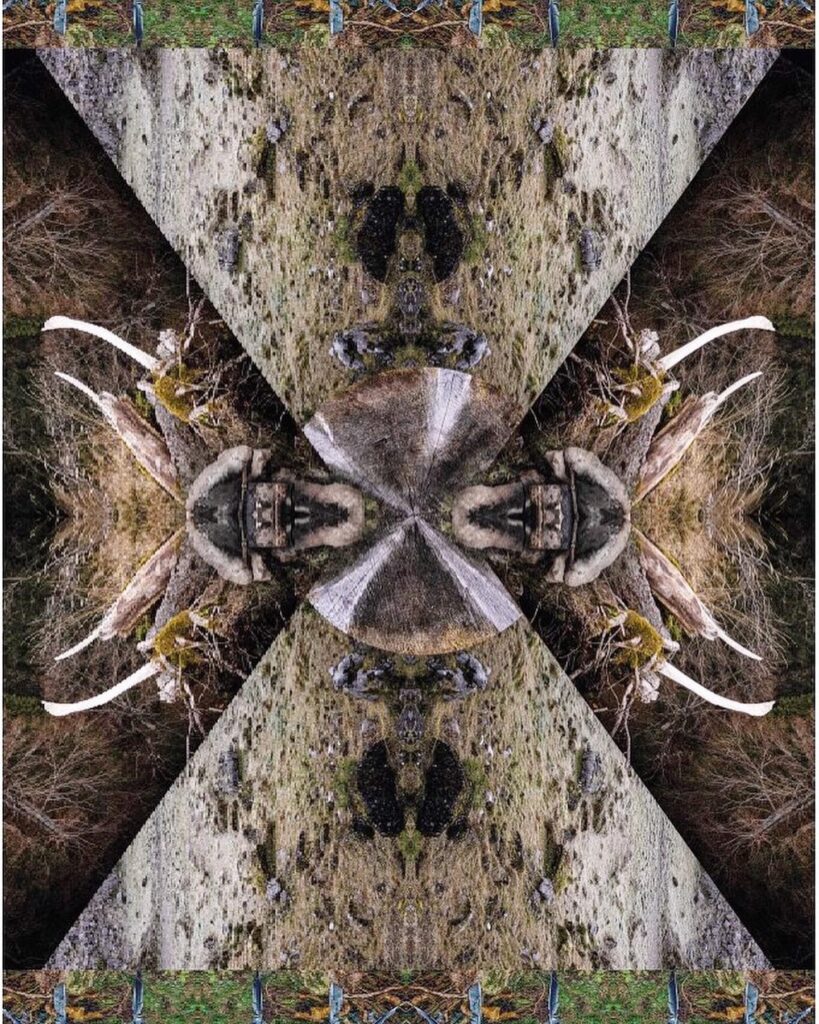
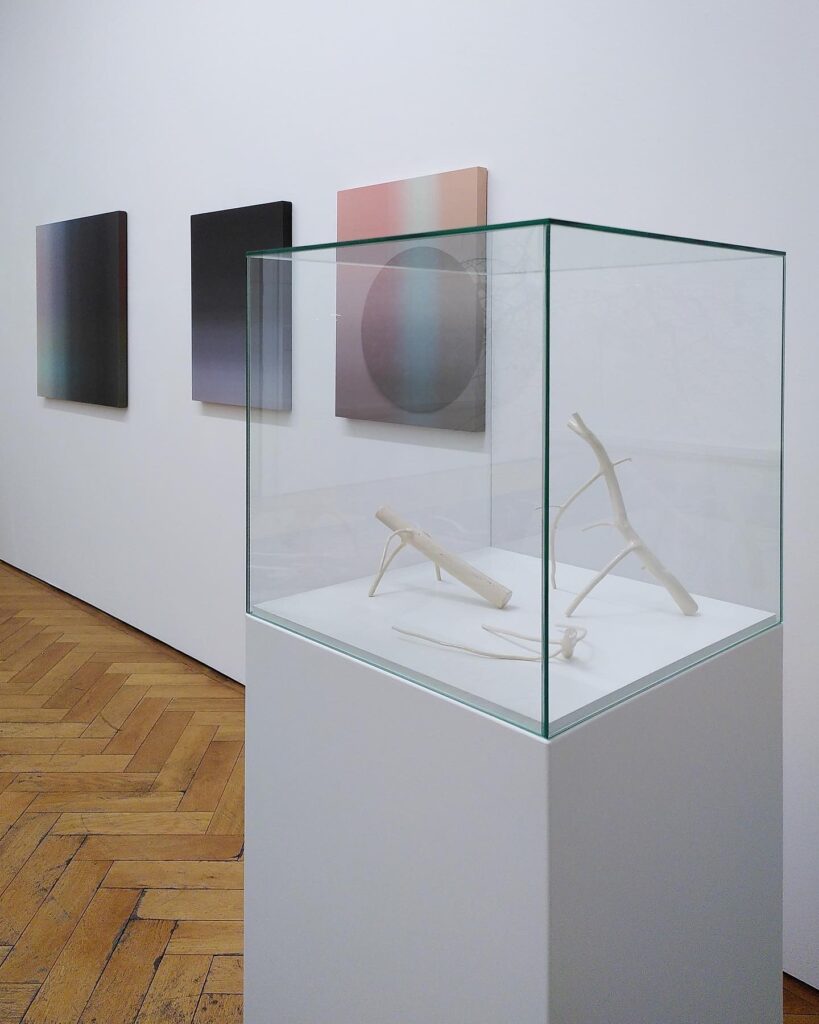
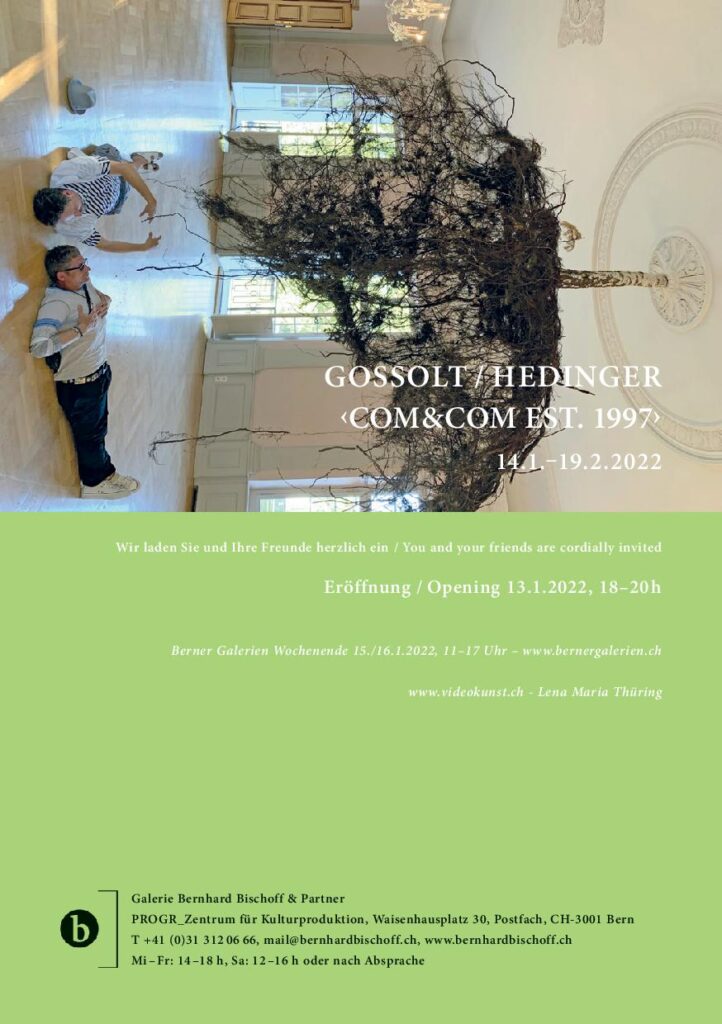
25 year Anniversary Show at Bernhard Bischoff Gallery Bern. 50 works from 25 years + 2 new work cycles. Trees in collaboration with Diebold/Zgraggen, carpets with Martin Leuthold. – on show until Feb 19.  –  Work/Price list